

Case Study
Streamlining Sample Tracking with Cryogenic Labels and the DYMO®LabelWriter™ 550

How a pulmonary fibrosis research laboratory simplified small-batch label printing and improved frozen sample management
Customer Background
The Mahavadi lab at Justus Liebig University Giessen in Germany, investigates the molecular and ncellular mechanisms driving Idiopathic Pulmonary Fibrosis (IPF). At the center of this research is the health of alveolar epithelial cells—the cells that line the tiny air sacs in the lungs where oxygen exchange occurs. In Idiopathic Pulmonary Fibrosis, these cells experience repeated injury and struggle to recover. Key cellular processes that normally help maintain cell health—such as waste removal (autophagy), recycling systems within the cell (lysosomal function), and energy production (mitochondrial activity)—become impaired.
More recently, the group has begun to look into how RNA-binding proteins help control how genetic instructions are used within the cell, and influence which disease-related genes are turned on or off. The goal to identify novel therapeutic targets for IPF disease.
The lab consists of multiple graduate students, and post-docs, running experiments to further the research efforts of Dr. Poornima Mahavadi, including Ms. Bhavika Katariya. As the breadth of the previously explained research is quite diverse, experimental components could include 2D and 3D eukaryotic cell models, drug samples, recombinant proteins, or even protein lysates. Each lab member had the potential of running multiple simultaneous experiments, each then consisting of several sub-experiments. The combination of the different iterations being tested meant that hundreds of different samples were being frozen for short- and long-term storage at temperatures ranging from -20°C to -196°C (liquid nitrogen), and thawed for use on a regular basis. It also meant that greater than one thousand labels might need to be printed for attachment to 0.5 mL and 1.5 mL tubes, cryogenic storage tubes, storage boxes, etc., on an almost weekly basis to meet the experimental needs of the team.
The Sample Tracking Challenge
Even though the total label printing needs of the lab could reach over 1000 labels per week, the experiments conducted by Ms. Katariya often differed from those performed by the rest of the team. As she explained, “We weren’t printing large quantities of just one label. Each person needed small batches of many different labels, depending on the experiment.”
The lab tried printing labels onto cryogenic label sheets to simplify their labeling workflow. However, even when using stored label templates, issues arose, causing the desired information to be misaligned with regard to the center of the label, and extend off the edge.
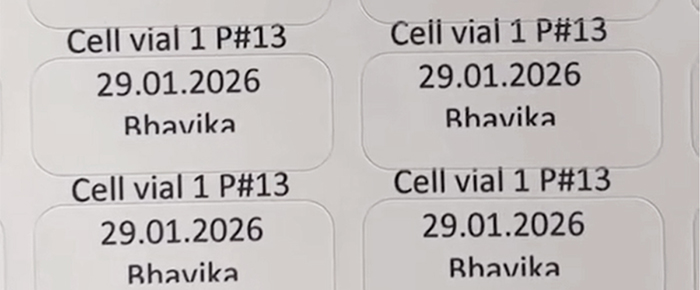
Due to these labeling challenges, researchers were often forced to choose between spending valuable time troubleshooting label printing issues or manually labeling each tube and vial. When samples were hand-labeled, information was frequently abbreviated to avoid delaying critical experimental workflows. This increased the risk of misinterpretation or misidentification later in the process, potentially resulting in experimental errors, repeated work, and lost productivity.
Alternatively, when labels were printed, researchers often prepared them a day in advance to avoid disruptions during experiments. While this reduced the risk of printer-related delays, it consumed valuable time and limited the flexibility to modify sample information in real time as experimental conditions evolved.
Tailoring a Sample Tracking Solution
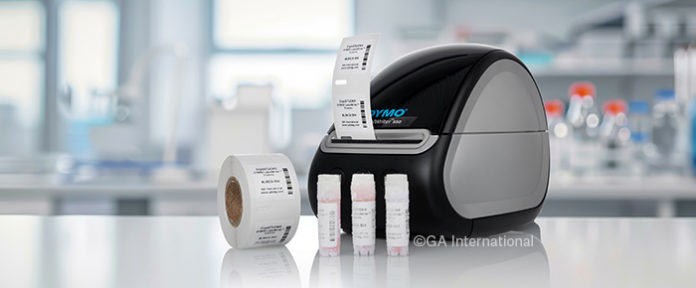
Ms. Katariya first discovered LabTAG labeling solutions through a bio-influencer on Instagram and subsequently connected with a LabTAG scientific label expert. Based on the Mahavadi lab’s needs, LabTAG recommended a combined solution: CryoSTUCK® cryogenic labels paired with the DYMO® LabelWriter™ 550 printer. This transition allowed the lab to move away from their time-consuming printing method and inconsistent handwritten labeling toward a streamlined, on-demand system designed for precision and flexibility.
With the DYMO® LabelWriter™ 550, researchers could now generate small batches of labels instantly, whether for a single vial or multiple experimental conditions, without formatting issues or alignment errors. As soon as the label roll was added to the printer, a template was generated that allowed information to be added quickly and easily. Each label printed clearly, and consistently, with proper centering, eliminating the trial-and-error process previously required,
and saving each user’s valuable time.
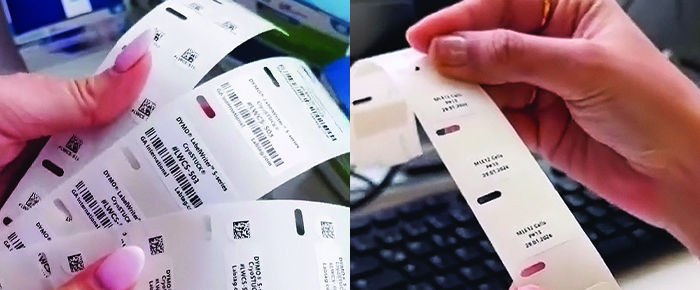
The printer’s small size also allowed Ms. Katariya to easily move it between different areas of the lab, making it convenient to print labels wherever they were needed.
“LabTAG DYMO labels are a great fit for the lab because they stay intact during cell freezing, alcohol wiping, and long-term cryogenic storage,” said Ms. Katariya. “It’s a small change, but it makes the workflow smoother, more organized, and honestly a lot calmer.”
The Mahavadi lab also needed labels that could withstand demanding storage conditions while supporting day-to-day sample handling. In some cases, due to smudged writing from information previously recorded directly on tubes, or legacy labels partially falling off tubes, Ms. Katariya and her team occasionally needed to exchange or add new labels to samples that had already been placed into low-temperature storage, including -20°C and -80°C freezers, as well as -196°C liquid nitrogen storage. Allowing these samples to thaw was not an option, as it could compromise their biological stability or efficacy. CryoSTUCK® labels solved this challenge by enabling researchers to apply new labels to already frozen tubes and vials at temperatures as low as -80°C. This capability helped preserve sample integrity while improving traceability and workflow efficiency.
Labeling became a seamless part of the workflow, naturally integrated into day-to-day lab activities. Researchers could focus on their experiments with confidence, knowing every sample was clearly, accurately, and securely labeled exactly when and where it was needed.
Conclusion
The introduction of the LabTAG labels, and DYMO® LabelWriter™ 550 transformed the Mahavadi laboratory’s labeling process, and improved overall organization. Researchers could generate labels on demand for a single vial, or multiple experimental conditions. Once a label roll was loaded, the specific type was automatically recognized, and appropriate template generated. Allowing information to be entered quickly and accurately. Labels printed consistently with
precise alignment and clear, legible text.
Further enhancing productivity, DYMO Connect™ software provides seamless integration to spreadsheets and databases; enabling automatic population of label data and reducing manual entry errors. The software supports a broad range of 1D and 2D barcode symbologies, including QR Codes, Data Matrix, Code 128, UPC, and others, allowing laboratories to implement reliable sample identification, tracking, and inventory management systems with ease. The combination of labels, printer, and software, eliminated a frustrating trial-and-error process, and saved valuable time. Ms. Katariya explains: “Since LabTAG labels became part of my lab routine, the difference has been remarkable. It’s fast, reliable, and honestly one of the best organizational investments I’ve made in my research space.”
Related Case Studies
Read All Case Studies ➡

University
The Cryo Labels CVIS Needed to Eliminate Sample Loss
Cryo-LazrTAG™
CryoSTUCK®
Read The Story


Neuroscience
How LabTAG Helped C-BIGR Optimize Sample Storage
NitroTAG®
Blackout CryoSTUCK®
Read The Story

Healthcare
Inside CEYMH: A Smarter Approach to Sample Identification
Inkjet Labels
Cryogenic
Read The Story